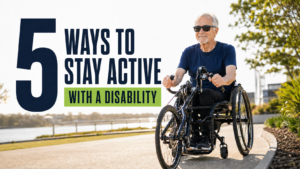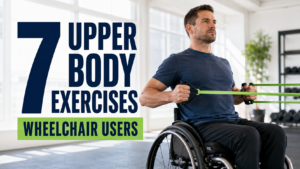

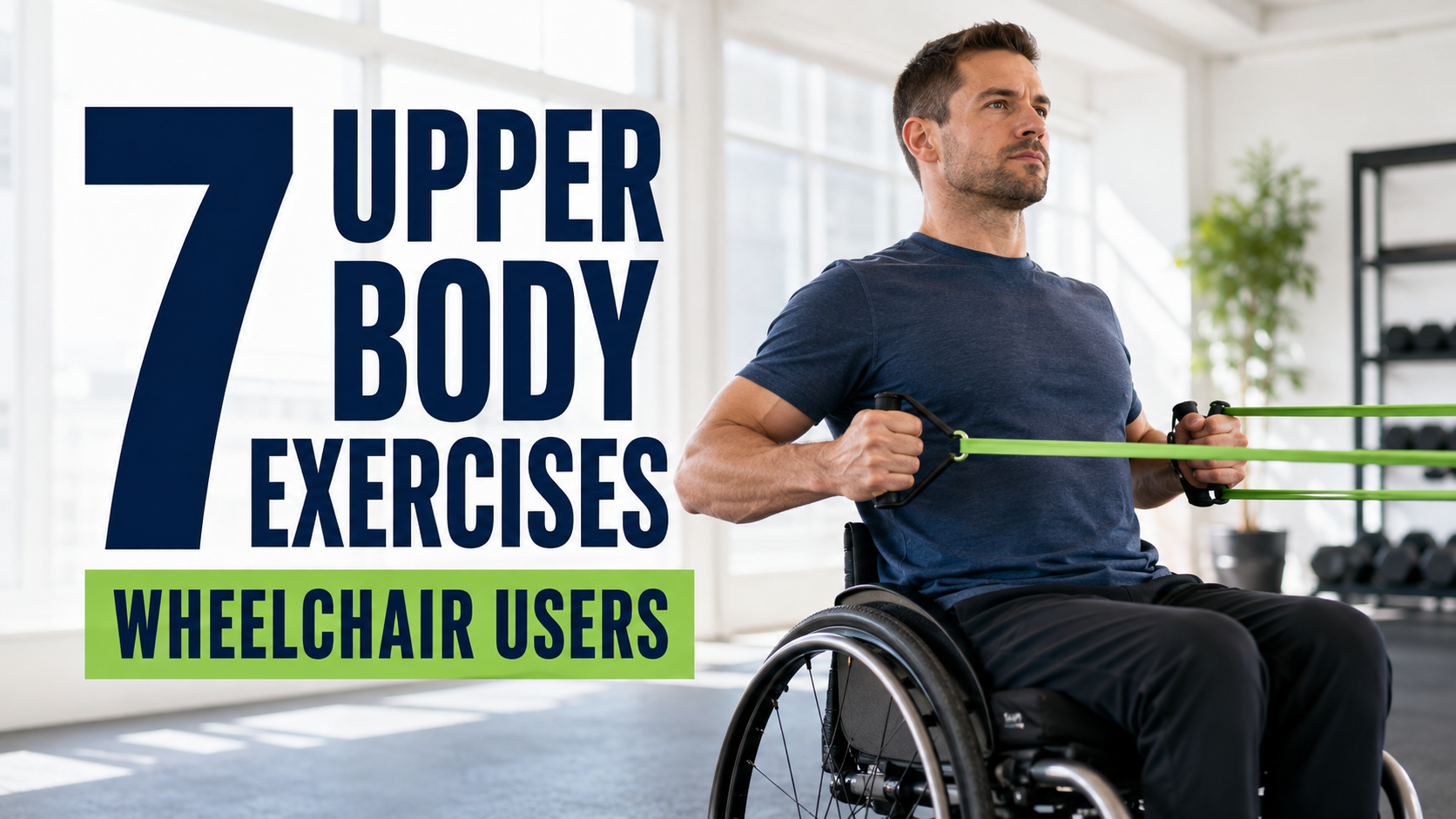
Upper body strength is what makes a manual wheelchair go. Self-propelling, reaching the wheels, locking the brakes and getting through a doorway all draw on the shoulders, arms, back and core. Seven exercises cover most of that work: ball squeezes, shoulder taps, bicep curls, shoulder extension, seated deadlifts, arm bike or swimmers, and seated rows. Each one can be made easier or harder to suit where you are now.
The World Health Organization’s guidelines for adults living with disability put the weekly target at 150 to 300 minutes of moderate-intensity activity plus muscle-strengthening work on two or more days. The same guidelines state that doing some activity beats doing none, so the target is a direction rather than an entry requirement.
Why upper body strength matters for wheelchair users
Getting around independently in a manual wheelchair means self-propelling, and upper body strength is what makes that possible. Regular exercise improves cardiovascular function and muscle strength for most wheelchair users, and it helps prevent injury, ease pain and support the everyday tasks that happen outside the chair.
Limited mobility does not mean you cannot exercise. Prolonged sitting carries its own health costs, which gives wheelchair users more reason to train rather than less.
Propelling with real force draws on the upper body and the lower body together. Posture and body alignment in the chair matter as well, because both affect how easily you move and how comfortable you are once you get there.
Strength on its own is not the whole picture. A mix of upper body resistance work, cardiovascular exercise, core and back exercise, flexibility work and functional practice is what builds independence with wheelchair mobility.
How much exercise wheelchair users should aim for
The World Health Organization’s 2020 guidelines set the same weekly targets for adults living with disability as for everyone else:
- 150 to 300 minutes of moderate-intensity aerobic activity a week, or 75 to 150 minutes of vigorous-intensity activity, or an equivalent mix of the two
- muscle-strengthening activity at moderate or greater intensity, covering all major muscle groups, on two or more days a week
- less sedentary time overall, with activity of any intensity, including light activity, counting towards the benefit
Start with small amounts and build the frequency, intensity and duration over time. The guidelines note there are no major risks in physical activity for adults living with disability when the activity suits your current activity level, health status and physical function.
7 upper body exercises for wheelchair users
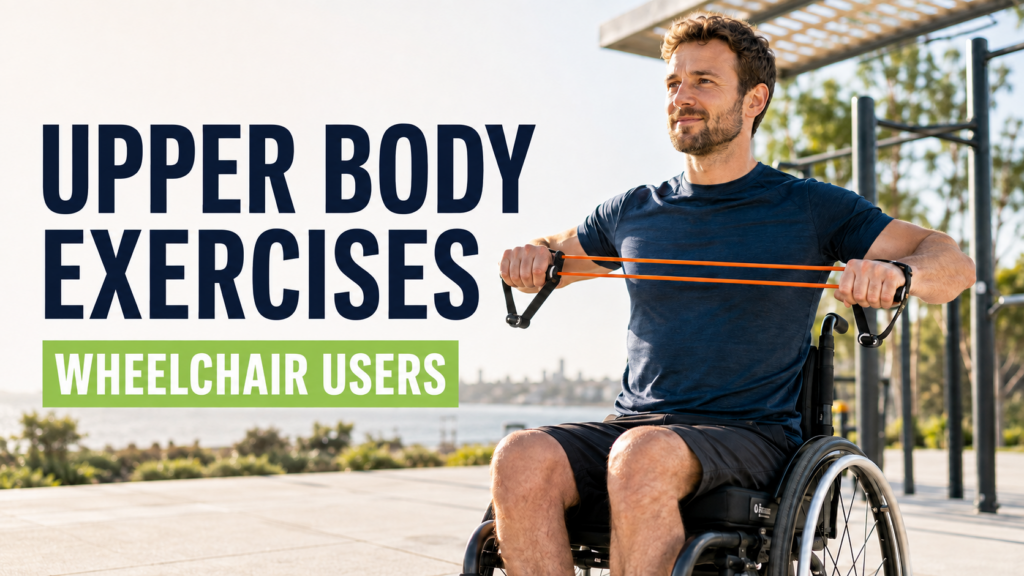
Seven exercises cover the range a wheelchair user needs: grip, shoulder range of motion, arm and back strength, core control and endurance. These are the movements used in seated strength sessions built for wheelchair users and people with spinal cord injuries, with modifications available on each one.
1. Ball squeeze
Squeezing a ball builds grip strength, which you need both for propelling the chair and for the force to lock and unlock the brakes.
2. Shoulder taps
Tapping your shoulders improves range of motion through the shoulders, which is what lets you reach the wheels and the brakes. Progress by adding reps, or by tapping higher up the shoulder or further back towards the shoulder blades. If a shoulder is sore, reduce the range of motion, or move through it under your own power rather than being moved through it.
3. Bicep curls
Curls build strength in the biceps, the large arm muscle you rely on to propel. Progress with heavier dumbbells, by working both arms at once, or by adding reps.
4. Shoulder extension
Shoulder extension builds strength and range of motion in the shoulders together. Progress by reaching further back towards a target, by adding reps, or by adding a resistance band.
5. Seated deadlifts
Seated deadlifts engage the core and train a proper hip hinge, which is what keeps your body aligned in the chair. Progress by adding reps, or by scooting forward so you are sitting unsupported, which brings balance into it.
6. Arm bike or swimmers
Both build endurance and coordination through the arms, which feed straight into propelling. Interval training suits this one, and it doubles as cardiovascular work.
7. Seated row
Rows improve posture alongside upper body strength. Progress by adding a resistance band, by moving faster, or by adding reps.
Every one of these has a built-in way to make it harder. Add reps, add a band or a heavier weight, or widen the range of motion once you can complete the current version comfortably.
Other ways to work on wheelchair mobility
Upper body strength work is one part of wheelchair mobility. Practising the actual skills of moving around in the chair builds the coordination and problem-solving that strength on its own does not.
Stop and go: on a straight, clear path, propel and stop at varying intervals. It builds endurance and doubles as upper body strength training.
Navigating obstacles: set out cones or other objects on the floor and propel around them. This works coordination, body control, turning and visual perception.
Doorway management: getting through a doorway independently affects a lot of daily life, so practise it often, along with exercises that help you press forward to open a door. An occupational therapist can also recommend changes to the environment that make doorways easier to get through.
Exercising safely as a wheelchair user
There are no major risks in physical activity for adults living with disability when the activity suits your current activity level, health status and physical function. Start with small amounts, then build the frequency, intensity and duration over time.
Shoulder pain is a signal to adjust rather than push through. Reduce the range of motion, or move through it under your own power instead of being moved through it, before adding load or range back.
You may need a health professional or a physical activity and disability specialist to work out which type and amount of activity suits you. An exercise physiologist can set the program up and adjust it as you progress, with form cues suited to wheelchair users rather than the standard version of each movement.