
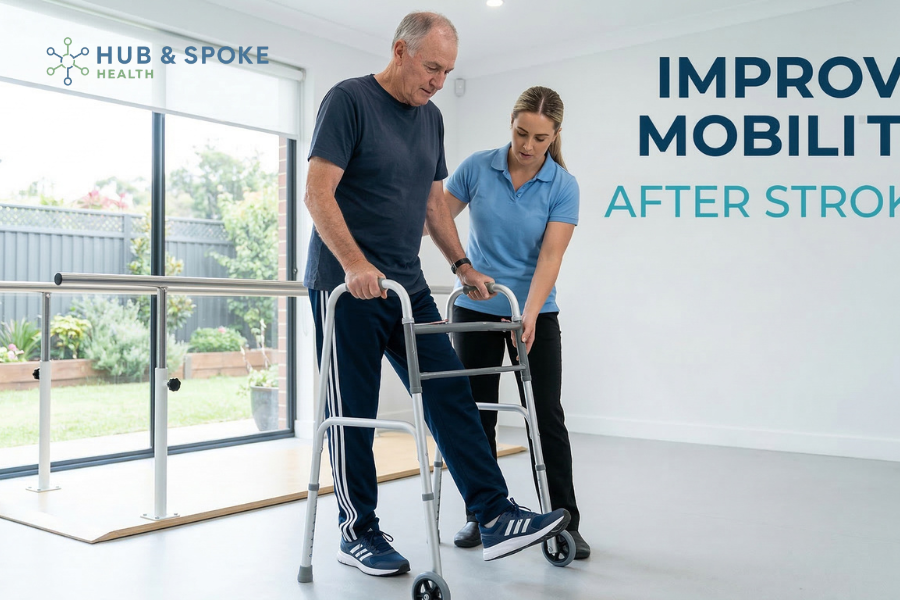
Improving mobility after a stroke involves consistent, repetitive exercises that help the brain form new connections to control movement. A combination of range-of-motion stretches, strengthening exercises, balance training, and walking practice can help stroke survivors regain independence and move more confidently at home.
Stroke is a leading cause of disability in Australia, with over 445,000 survivors living in the community [1]. Approximately 74% of stroke survivors report ongoing mobility problems, and two-thirds experience impaired mobility in the initial period after their stroke [2][3]. These numbers highlight how common mobility challenges are, but they also underscore the importance of targeted rehabilitation. The brain has a remarkable ability to adapt and rewire after injury, and the right exercises tap into that process.
This guide explains how neuroplasticity supports stroke recovery, then covers practical exercises organised by recovery stage: early, mid, and later. You’ll also find balance exercises, safety guidelines, and information about how mobile physiotherapy can support rehabilitation at home.
Important: Every stroke is different. The exercises in this guide are general recommendations based on physiotherapy evidence. Always work with your physiotherapist or doctor to confirm which exercises are appropriate for your specific situation, particularly if you have severe weakness, spasticity, or other medical conditions.
How the Brain Rebuilds Movement After Stroke
Understanding how your brain recovers helps explain why certain exercises work and why repetition matters so much.
When a stroke damages part of the brain, the neurons in that area can no longer send signals to control movement. However, the brain has a built-in recovery mechanism called neuroplasticity. This is the brain’s ability to reorganise itself by forming new neural connections in healthy areas, allowing those regions to take over functions that were lost [4].
Neuroplasticity responds to repetition. The more you practise a specific movement, the stronger the new neural pathways become. Research suggests the brain may need 400 to 1,600 repetitions of a movement per day to establish reliable new connections [5]. That sounds like a lot, but it includes every single attempt, even partial ones. Ten minutes of ankle pumps done throughout the day adds up quickly.
The “sensitive window” for neuroplasticity is the first 60 to 90 days after a stroke, when the brain is most receptive to change [4]. However, meaningful improvement is possible months and even years after a stroke with consistent, targeted practice. The principle is straightforward: use it or lose it, and use it and improve it. Functions that are regularly practised get stronger. Functions that are neglected can decline.
This is why the exercises below focus on progressive, stage-based practice rather than a single list of movements. You start where your body is today and build from there.
Exercises for Early-Stage Stroke Recovery
Early-stage exercises suit stroke survivors who are mostly in bed or sitting in a chair, with limited voluntary movement on the affected side. A caregiver or family member may need to assist with some of these movements. The goal at this stage is to maintain joint flexibility, prevent muscle shortening, and begin stimulating neural pathways.
Passive Range of Motion
Purpose: Prevent joint stiffness and muscle contractures on the affected side
If you have little or no voluntary movement in your affected arm or leg, a caregiver can gently move the limb through its natural range of motion.
- Shoulder: Slowly raise the affected arm forward and overhead (as far as is comfortable), then lower it. Repeat 10 times.
- Elbow: Gently bend and straighten the affected elbow. Repeat 10 times.
- Wrist and fingers: Slowly bend and extend the wrist and open and close the fingers. Repeat 10 times each.
- Hip and knee: While lying on the back, gently bend the affected knee toward the chest, then straighten. Repeat 10 times.
- Ankle: Gently move the foot up and down, and in circles. Repeat 10 times in each direction.
Passive range of motion exercises preserve joint health and send sensory signals to the brain, reinforcing the neural connections needed for eventual voluntary movement [3]. Perform these 2 to 3 times per day.
Ankle Pumps and Circles
Purpose: Improve circulation, maintain ankle flexibility, prepare for walking
- Sit in a chair or lie on your back with legs extended.
- Slowly point your toes away from you (plantarflexion).
- Then pull your toes back toward your shin (dorsiflexion).
- Repeat this pumping motion 15 to 20 times.
- Then rotate your ankles in circles, 10 times clockwise and 10 times anticlockwise.
Ankle mobility directly affects walking ability. Reduced ankle dorsiflexion is one of the most common causes of foot-drop and tripping during gait recovery [6]. Starting these movements early helps maintain the flexibility needed for safe walking later.
Seated Knee Extension
Purpose: Strengthen quadriceps, prepare for standing
- Sit upright in a sturdy chair with your feet flat on the floor.
- Slowly extend your affected leg out in front of you until the knee is as straight as possible.
- Hold for 3 to 5 seconds.
- Slowly lower your foot back to the floor.
- Repeat 10 times on each leg.
Quadriceps strength is essential for standing up from a chair, supporting your weight during walking, and climbing stairs. This exercise activates the thigh muscles while keeping you safely seated [6].
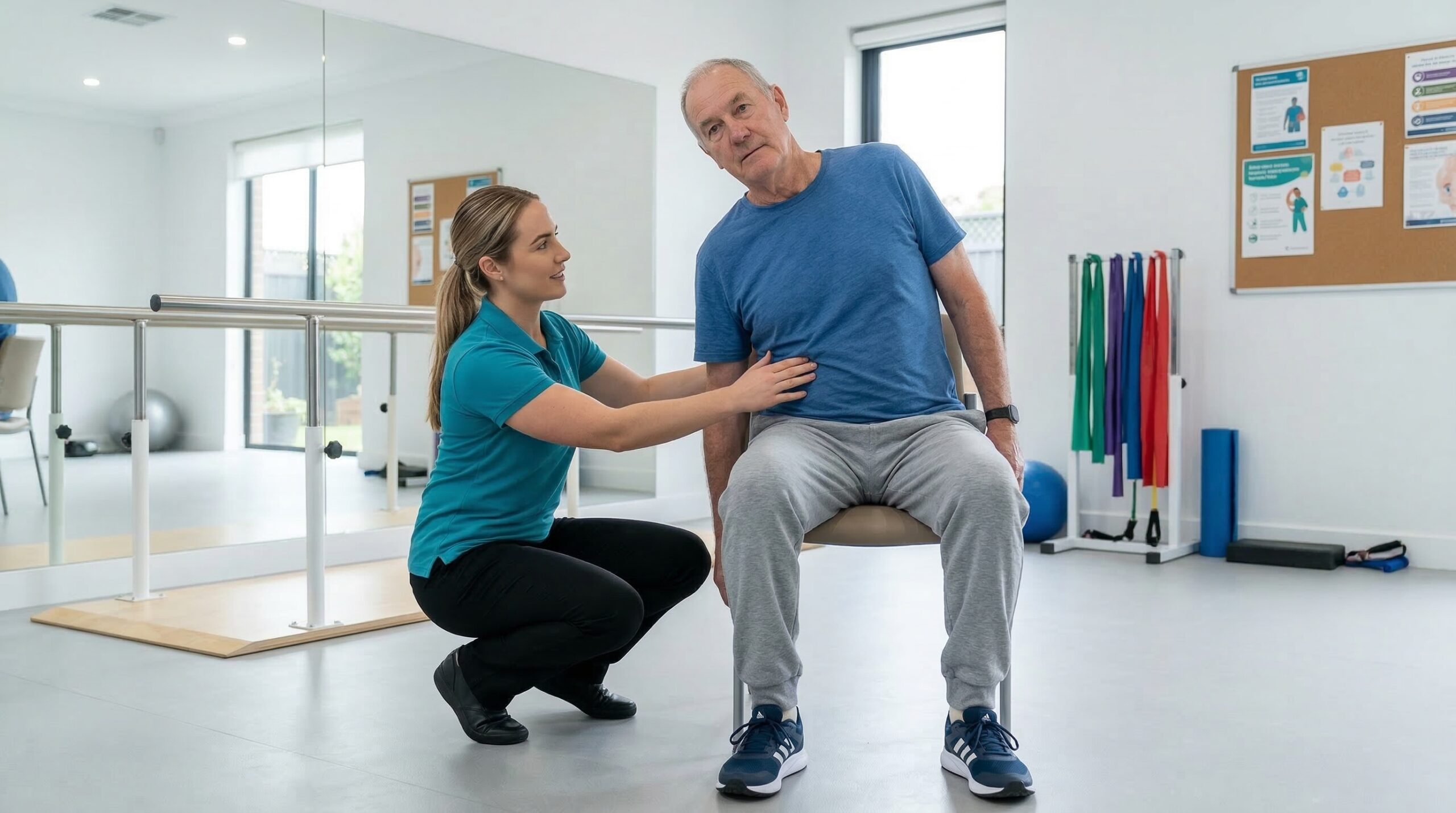
Seated Weight Shifting
Purpose: Improve trunk control and core awareness
- Sit on the edge of a firm chair with both feet flat on the floor, hip-width apart.
- Slowly lean your upper body to the right, then return to centre.
- Lean to the left, then return to centre.
- Lean slightly forward, then return upright.
- Repeat the full sequence 8 to 10 times.
Trunk control is the foundation for balance and independent movement. Many stroke survivors develop an asymmetric sitting posture, leaning away from the affected side. Weight shifting exercises train the core muscles to stabilise the trunk equally in all directions [6].
Exercises for Mid-Stage Stroke Recovery
Mid-stage exercises suit stroke survivors who can sit independently and are beginning to stand with support. The affected side is showing more voluntary movement, though it may still be significantly weaker than the unaffected side. The goal at this stage is to build strength, practise functional movements, and introduce supported standing.
Sit-to-Stand Transfers
Purpose: Build lower limb and core strength for one of the most important daily movements
- Sit at the front of a sturdy chair with your feet flat, hip-width apart. If needed, place a stable surface (like a bench or table) in front of you for support.
- Lean your upper body slightly forward, bringing your nose over your toes.
- Push through both feet to stand up, distributing your weight as evenly as possible between both legs.
- Pause for 3 seconds at the top.
- Slowly lower yourself back to sitting by bending your hips and knees together.
- Repeat 8 to 10 times.
Sit-to-stand transfers are one of the most functional exercises in stroke rehabilitation. Being able to stand from a chair affects almost every aspect of daily life, from going to the bathroom to getting in and out of bed. Practising this movement repeatedly strengthens the neural pathways for the entire sitting-to-standing sequence [5].
Supported Heel Raises
Purpose: Strengthen calf muscles, improve ankle stability for walking
- Stand behind a sturdy chair or kitchen bench, holding on for support.
- Slowly rise onto your toes, lifting both heels off the floor.
- Hold for 2 to 3 seconds at the top.
- Slowly lower back down.
- Repeat 10 to 15 times.
If your affected leg is significantly weaker, start by performing heel raises with most of your weight on the unaffected side, then gradually shift more weight onto the affected leg as strength improves. Calf strength is critical for the push-off phase of walking [6].
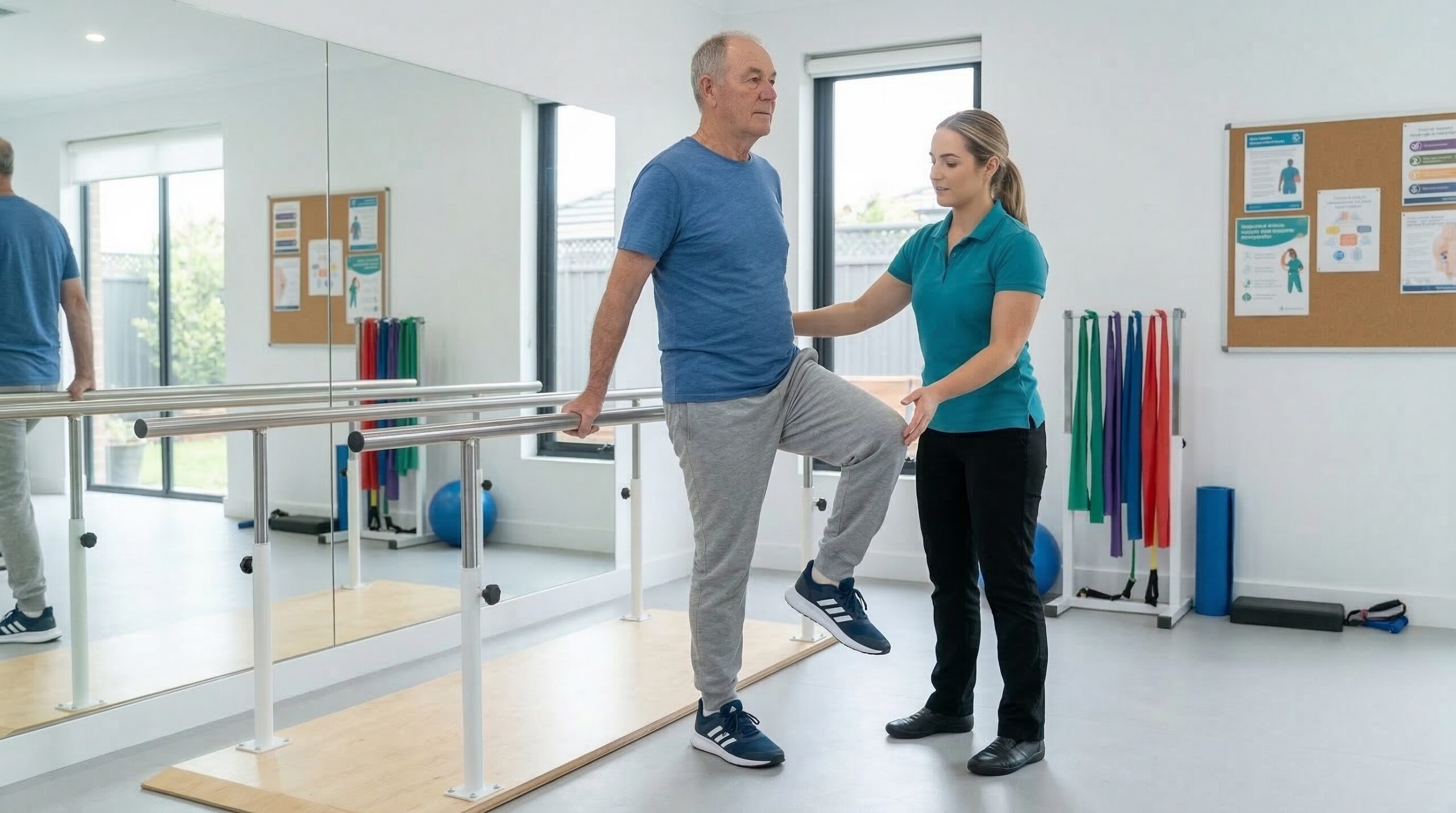
Supported Marching in Place
Purpose: Practise the leg-lifting pattern needed for walking
- Stand behind a chair, holding on with both hands for balance.
- Slowly lift your right knee toward your chest (as high as is comfortable).
- Lower your foot back to the floor.
- Repeat with the left knee.
- Alternate for 20 total steps (10 on each side).
Marching in place mimics the stepping pattern of walking in a controlled, safe environment. It trains hip flexion (the ability to lift the leg) and weight shifting from one foot to the other, both of which are essential for functional walking [6].
Seated Trunk Rotation
Purpose: Improve spinal mobility and core activation
- Sit upright with feet flat on the floor and arms crossed over your chest.
- Slowly rotate your upper body to the right, keeping your hips facing forward.
- Hold for 3 seconds, then return to centre.
- Repeat to the left.
- Complete 10 repetitions on each side.
Trunk rotation strengthens the oblique muscles and spinal rotators, which are essential for maintaining balance during walking and reaching activities. Stroke survivors often lose rotational control on the affected side, leading to an asymmetric gait pattern. Restoring this movement improves walking efficiency and reduces compensatory patterns [6].
Exercises for Later-Stage Stroke Recovery
Later-stage exercises suit stroke survivors who can stand independently (with or without a walking aid) and are working on improving walking quality, endurance, and confidence. The goal is to refine movement patterns, increase walking distance, and build the strength needed for community-level mobility.
Toe Taps
Purpose: Improve ankle control and coordination
- Stand behind a chair for support.
- Tap your right toes forward, then return to centre.
- Tap the same foot out to the side, then return.
- Tap behind you (if balance allows), then return.
- Repeat the full sequence 8 times on each foot.
Toe taps train the fine ankle and foot control needed for safe walking on uneven surfaces. They also challenge dynamic balance by shifting your centre of gravity in multiple directions [7].
Heel-to-Toe Walking
Purpose: Improve walking balance and coordination
- Stand near a wall or bench for safety.
- Place one foot directly in front of the other so the heel of your front foot touches the toes of your back foot.
- Take 10 to 15 steps in a straight line, heel to toe.
- If this feels unstable, leave a small gap between your heel and toes and reduce the gap as your balance improves.
Heel-to-toe walking (tandem walking) narrows your base of support, forcing your balance system to work harder. Physiotherapists use this exercise as both a training tool and an assessment of balance improvements over time [7].
Side Stepping
Purpose: Strengthen hip abductors, improve lateral stability
- Stand with your back to a kitchen bench, holding on for light support.
- Step to the right with your right foot, then bring your left foot to meet it.
- Take 10 steps to the right, then 10 steps back to the left.
- Keep your toes pointing forward throughout and avoid crossing your feet.
Hip abductor weakness on the affected side is a common cause of unsteadiness during walking. Side stepping directly strengthens these muscles and improves lateral weight shifting, reducing the risk of sideways falls [7].
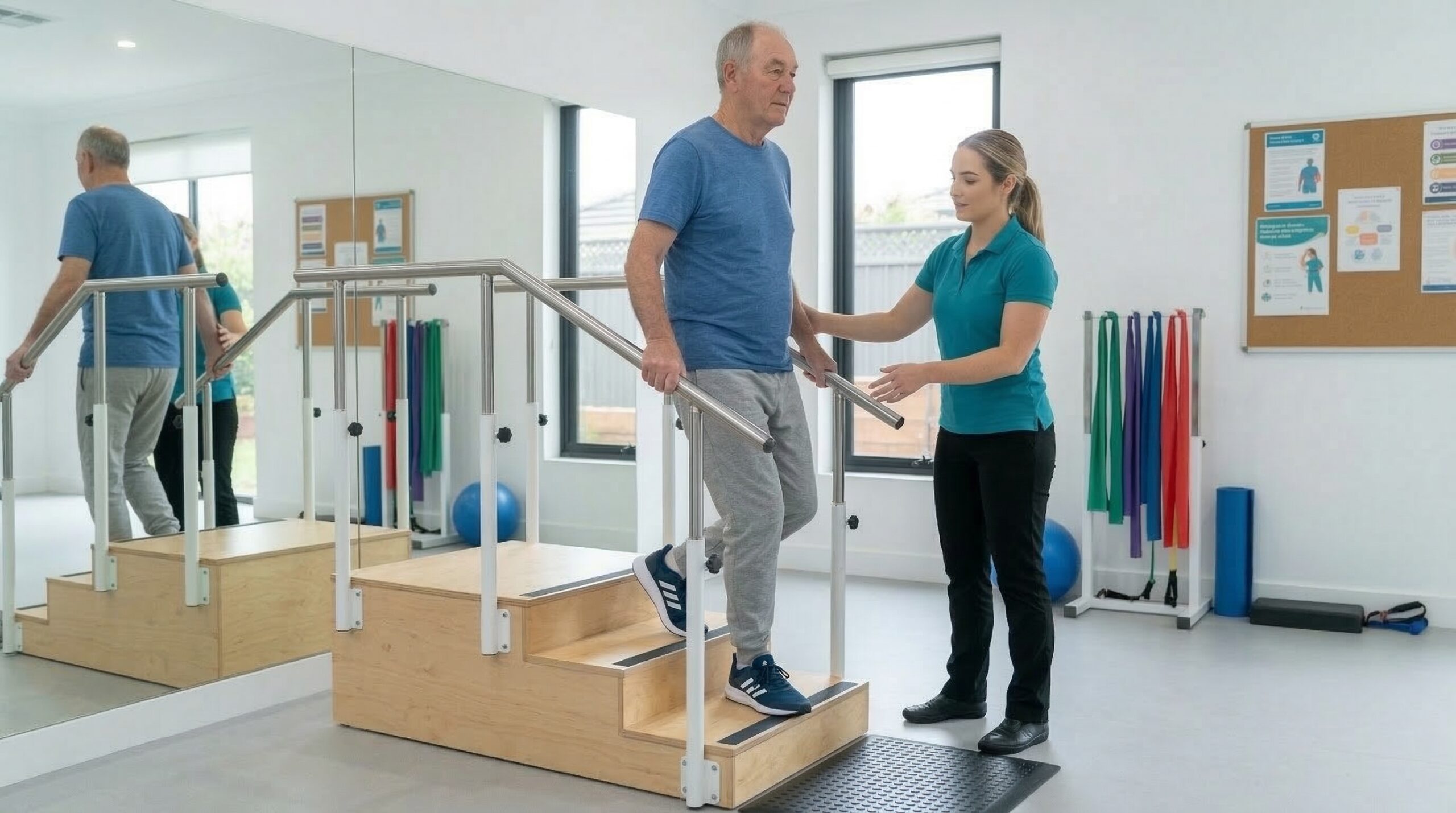
Stair Practice
Purpose: Build leg strength and confidence for real-world mobility
- Use a staircase with a handrail. Start with a single step if a full flight feels too challenging.
- Going up: Lead with your stronger leg, then bring the affected leg to meet it. Use the handrail for support.
- Going down: Lead with your affected leg, then bring the stronger leg down. Use the handrail.
- Repeat 5 to 8 times up and down.
The traditional guidance is “up with the good, down with the bad.” This ensures your stronger leg does the heavier work of pushing upward, while your affected leg handles the controlled lowering (which is less demanding). Stair practice is one of the most important functional exercises for regaining community-level independence [6].
Balance Exercises to Reduce Falls After Stroke
Falls are a serious risk for stroke survivors. Impaired balance, reduced sensation, and muscle weakness on the affected side all increase the likelihood of falling. The Stroke Foundation reports that falls prevention is a critical component of stroke rehabilitation.
Standing Weight Shifts
- Stand behind a chair, holding on lightly.
- Shift your weight onto your right foot, holding for 5 seconds.
- Return to centre, then shift onto your left foot for 5 seconds.
- Repeat 10 times on each side.
- Progress by reducing the amount of support from the chair.
Weight shifts teach your brain to trust and load the affected leg, which many stroke survivors unconsciously avoid. Gradual loading builds both strength and confidence.
Single-Leg Standing
- Stand behind a chair with both hands on the chair back.
- Slowly lift one foot off the ground, keeping your standing leg slightly bent.
- Hold for 10 seconds (or as long as you can manage safely).
- Repeat 5 times on each leg.
- Progress by using one hand, then one finger, then no hands as your balance improves.
Single-leg standing is a fundamental balance exercise that strengthens the ankle, knee, and hip stabilising muscles on the standing leg. It also challenges your vestibular (inner ear) and proprioceptive (body position awareness) systems to maintain your posture [7].
Safety Guidelines for Stroke Recovery Exercises
Stroke recovery exercises carry unique considerations compared to general fitness training. Follow these guidelines to exercise safely.
Work with your physiotherapist:
- Your physio should assess your movement, strength, and balance before recommending specific exercises. What works at one stage of recovery may not suit another stage.
- If you experience increased spasticity (involuntary muscle tightness) during an exercise, discuss this with your therapist. Some exercises can temporarily increase tone, and your programme may need adjusting.
Recognise fatigue:
- Post-stroke fatigue is real and different from normal tiredness. If you feel mentally foggy, unusually irritable, or physically heavy, rest before continuing.
- Short exercise sessions spread throughout the day (10 to 15 minutes, 2 to 3 times daily) are more effective than one long session for most stroke survivors.
Manage your environment:
- Remove loose rugs and tripping hazards before exercising.
- Exercise near a wall, sturdy furniture, or with a caregiver nearby for support.
- Wear non-slip footwear or go barefoot on a non-slip surface.
- Ensure good lighting so you can see where you’re stepping.
When to stop and seek help:
| Warning Sign | Action |
| Sudden severe headache | Stop immediately and call 000 |
| New weakness or numbness | Stop immediately and call 000 |
| Difficulty speaking or understanding | Stop immediately and call 000 (possible recurrent stroke) |
| Sharp pain in a joint | Stop the exercise and consult your physiotherapist |
| Increased dizziness that doesn’t settle | Rest and inform your physiotherapist |
| Chest pain or shortness of breath | Stop and seek medical attention |
These symptoms could indicate a recurrent stroke or other medical emergency. Always treat sudden neurological changes as an emergency.
Frequently Asked Questions
How long does it take to regain mobility after a stroke?
Most significant improvement occurs in the first 3 to 6 months after a stroke, when neuroplasticity is most active. However, measurable gains in mobility can continue for years with consistent, targeted exercise. The timeline varies widely depending on the size and location of the stroke, the person’s pre-stroke health, and the intensity of rehabilitation [4][5]. There is no fixed endpoint for recovery.
Can you fully recover mobility after a stroke?
Full recovery to pre-stroke mobility is possible for some people, particularly those who had a mild stroke with limited brain damage. For others, the goal shifts to maximising functional independence rather than returning to an identical pre-stroke level. Many stroke survivors achieve meaningful improvements that allow them to walk, dress, and manage daily activities independently, even if some asymmetry or reduced speed remains [3].
What exercises help with stroke recovery at home?
The most effective exercises depend on your current stage of recovery. In the early stages, passive range of motion and seated exercises (ankle pumps, knee extensions, weight shifting) prevent stiffness and begin reactivating neural pathways. In mid-stage recovery, sit-to-stand transfers, supported marching, and heel raises build functional strength. Later, balance exercises (single-leg standing, heel-to-toe walking) and progressive walking practice improve confidence and endurance [6][7].
How does physiotherapy help after a stroke?
A physiotherapist assesses your movement, strength, balance, and walking pattern, then creates a personalised exercise programme targeting your specific weaknesses. They guide you through progressive exercises that stimulate neuroplasticity, manage spasticity, and build the muscle strength needed for functional movements like standing, walking, and stair climbing. A mobile physiotherapist can deliver this care in your home, using your actual environment as the rehabilitation setting [3][6].
Keep Moving Forward
Stroke recovery is not a straight line. There will be days of noticeable progress and days that feel slower. What the research consistently shows is that the brain responds to effort. Every repetition, every attempt to stand, every step practised at home sends signals that help the brain rebuild the connections needed for movement [4][5].
Start where you are today. If that means seated ankle pumps with a caregiver’s help, that is exactly the right starting point. If it means practising stair climbing with a handrail, keep going. The exercises in this guide are organised by stage so you can progress at your own pace.
References
[1] Australian Stroke Coalition. (2020). “Stroke Survivors in Australia.” Retrieved from australianstrokecoalition.org.au[https://www.australianstrokecoalition.org.au]
[2] Stroke Foundation Australia. (2024). “Life After Stroke.” Retrieved from strokefoundation.org.au[https://strokefoundation.org.au]
[3] Mayo Clinic. (2024). “Stroke Rehabilitation.” Retrieved from mayoclinic.org[https://www.mayoclinic.org]
[4] NIH. (2023). “Stroke Rehabilitation in Australia: Gaps and Challenges.” Retrieved from nih.gov[https://www.nih.gov]
[5] Flint Rehab. (2024). “Neuroplasticity After Stroke.” Retrieved from flintrehab.com[https://www.flintrehab.com]
[6] Stroke Foundation Australia. (2024). “Clinical Guidelines for Stroke Management.” Retrieved from strokefoundation.org.au[https://strokefoundation.org.au]
[7] Saebo. (2024). “Evidence-Based Stroke Recovery Exercises.” Retrieved from saebo.com[https://www.saebo.com]