

Sciatica is one of the most common causes of pain in the lower back, legs, buttocks, and feet. It affects up to 40% of people at some point in their lives, and when it flares up, the discomfort can range from a dull ache to severe shooting sensations down one leg.
The good news is that many people can find relief at home. Targeted stretches, gentle exercises, and a few simple remedies can ease the pressure on the sciatic nerve and get you moving more comfortably again.
What Is Sciatica?
Sciatica occurs when the sciatic nerve, the longest nerve in the human body, becomes compressed or irritated. This nerve runs from your lower back through the hips and down each leg. Common triggers include herniated discs, spinal stenosis, injuries, and piriformis syndrome (where the piriformis muscle below your glutes spasms and presses against the nerve).
Symptoms of sciatica include:
- Numbness in the affected area
- Tingling or pins and needles from the lower back to the foot
- Shooting pains that radiate down one leg
- A dull ache anywhere along the sciatic region
- Lower back pain accompanied by discomfort in the buttock, leg, hip, or feet
Alleviating pressure on the sciatic nerve is the main goal of treatment. According to licensed physical therapist Mindy Marantz, identifying what doesn’t move is the first step toward solving the problem. Often, the most problematic body parts are the lower back and hips.
Dr. Mark Kovacs, a certified strength and conditioning specialist, adds that the best way to alleviate most sciatica pain is to do any stretch that can externally rotate the hip.
Stretches for Sciatica Relief
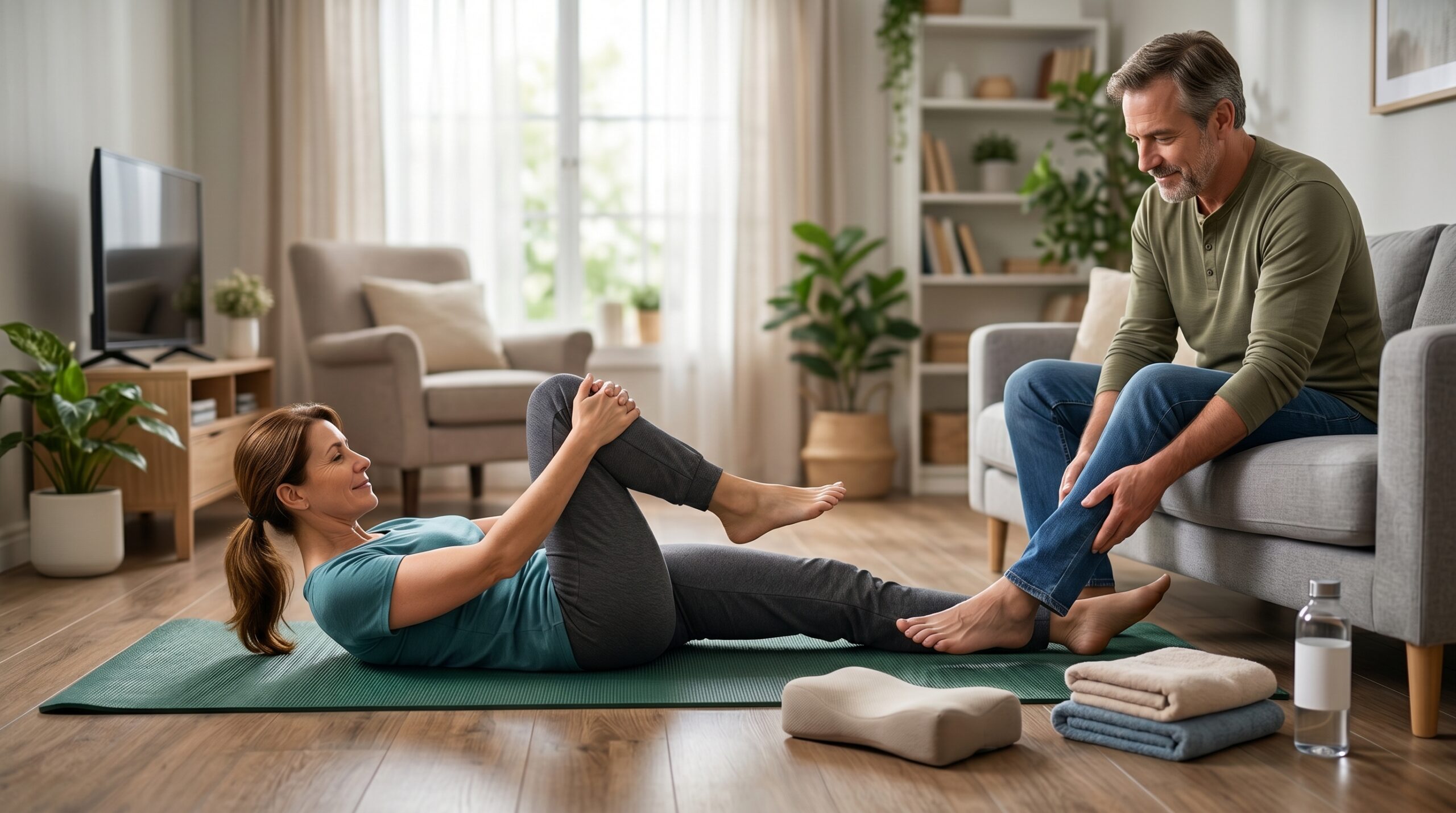
The following stretches target the glutes, piriformis, hamstrings, and lower back, all areas that can contribute to sciatic nerve compression. Hold each stretch for 15 to 30 seconds unless otherwise noted, and stop if you feel any sharp pain.
1. Seated Glute Stretch
This stretch targets the glutes and lower back, two areas closely connected to the sciatic nerve.
- Sit on the floor or a chair with your legs out in front of you.
- Bend your right leg and place your right ankle on top of your left knee.
- Lean forward and allow your upper body to reach toward your thigh.
- Hold for 15 to 30 seconds.
- Repeat on the other side.
2. Sitting Spinal Stretch
Sciatica pain can be triggered when vertebrae in the spine compress. This stretch helps create space in the spine to relieve pressure on the sciatic nerve.
- Sit on the ground with your legs extended straight out and your feet flexed upward.
- Bend your right knee and place your foot flat on the floor on the outside of your opposite knee.
- Place your left elbow on the outside of your right knee to help you gently turn your body toward the right.
- Hold for 30 seconds and repeat three times, then switch sides.
3. Figure-4 Stretch
The figure-4 stretch opens the hips and can help stretch the piriformis muscle, which is often involved in sciatic nerve compression.
- Lie flat on your back and bend both your knees.
- Cross your right foot over your left thigh, moving your legs up toward the torso.
- Hold the position for a moment, then repeat on the other side.
Don’t force this stretch. Allow gravity to bring your legs closer to your body naturally for a deeper, more comfortable stretch.
4. Knee to Opposite Shoulder
This simple stretch helps relieve sciatica pain by loosening the gluteal and piriformis muscles, which can become inflamed and press against the sciatic nerve.
- Lie on your back with your legs extended and your feet flexed upward.
- Bend your right leg and clasp your hands around the knee.
- Gently pull your right leg across your body toward your left shoulder. Hold for 30 seconds. Pull your knee only as far as it will comfortably go.
- Push your knee so your leg returns to its starting position.
- Repeat for a total of 3 reps, then switch legs.
5. Standing Hamstring Stretch
Tight hamstrings can mimic or worsen sciatica symptoms. This stretch helps ease pain and tightness in the hamstring caused by sciatic nerve irritation.
- Place your right foot on an elevated surface at or below hip level, such as a chair, ottoman, or step. Flex your foot so your toes and leg are straight. If your knee tends to hyperextend, keep it slightly bent.
- Bend your body forward slightly toward your foot. The further you go, the deeper the stretch. Don’t push so far that you feel pain.
- Release the hip of your raised leg downward as opposed to lifting it up.
- Hold for at least 30 seconds, then repeat on the other side.
6. Piriformis Stretch
If your sciatica is caused by piriformis syndrome, this stretch may provide targeted relief. You can do the seated version at your desk or the standing version if you have more space.
Seated version: sit on the edge of a chair and place the foot of your affected leg on the opposite knee. Keep your back straight as you lean forward from the hips as far as comfortable. Hold for up to 30 seconds, then swap sides. Repeat up to five times on each side.
Standing version: while standing, place your affected leg over the knee of your other leg. Bend your standing leg and try to form the number 4, keeping your hips at a 45-degree angle to the ground. Bend at the waist while holding your back straight. Stay in the position for 30 to 60 seconds, then switch legs. You can stand against a wall for extra balance.
7. Forward Pigeon Pose
This deeper stretch targets the piriformis and hip rotators. It requires more flexibility, so ease into it gradually.
- Kneel on the floor on all fours.
- Pick up your right leg and move it forward on the ground in front of your body. Your lower leg should be on the ground, horizontal to the body. Your right foot should be in front of your left knee while your right knee stays to the right.
- Stretch the left leg out all the way behind you on the floor, with the top of the foot on the ground and toes pointing back.
- Shift your body weight gradually from your arms to your legs so that your legs are supporting your weight. Sit up straight with your hands on either side of your legs.
- Take a deep breath. While exhaling, lean your upper body forward over your front leg. Support your weight with your arms as much as possible.
- Repeat on the other side.
Strengthening Exercises for Sciatica
Stretching alone isn’t always enough. Gentle strengthening exercises can help stabilise the muscles around your spine and pelvis, reducing the likelihood of future flare-ups.
8. Cat-Cow Pose
This gentle movement helps mobilise the spine and relieve tension in the lower back.
- Start on all fours with your knees positioned below your hips and your hands beneath your shoulders.
- With a gentle bend in the elbows, round your back while looking down towards the floor. Hold this position for a couple of seconds.
- Smoothly and slowly push your belly button towards the floor and arch your back downwards while looking up towards the ceiling.
- Repeat for several minutes or until you feel relief in your sciatic region.
9. Bridge Technique
The bridge strengthens your glutes while providing relief from sciatic nerve pressure.
- Lie on your back with your knees bent and hip-width apart. Place your hands on your stomach and keep your spine neutral.
- Using your stomach muscles for stability, slowly lift your pelvis off the floor until your body forms a diagonal line from your head to your knees.
- Hold for a few seconds, then lower your pelvis to the ground in a controlled motion.
- Repeat 8 to 10 times.
10. Quadruped Arm and Leg Lift
This exercise builds core stability and helps keep your spine properly aligned, which can reduce sciatic nerve irritation over time.
- Start on all fours with your knees positioned below your hips and your hands beneath your shoulders.
- Slowly stretch your left leg out behind you to its full extension and rest your toes on the floor, keeping your hips level.
- Reach your right arm out in front of you while gently raising your outstretched leg off the floor. Try to keep your spine level with no arching or rounding.
- Hold for six seconds, then lower your leg and arm to the floor and rest for ten seconds.
- Repeat several times on each side.
Other Home Remedies for Sciatica Pain
Beyond stretches and exercises, there are several simple remedies you can try at home for faster relief.
Rest for a Short Time
If your sciatica flares up after a lot of movement, taking the weight off your feet and resting for a few minutes can provide fast relief. However, staying in bed too long can cause muscle weakness, which often makes sciatica worse. Limit bed rest to no more than a day or two before getting active again.
A sedentary lifestyle can contribute to muscle weakness and stiffness that make sciatica symptoms more persistent, so finding a balance between rest and gentle movement is key.
Ice or Heat Packs
Ice packs (or even a bag of frozen peas) can reduce inflammation and sensation around your sciatic region. Hold an ice pack to the painful area for several minutes until you start to feel relief. If ice doesn’t work for you, a heat pack or hot water bottle may do the trick instead.
Low-Impact Exercise
Staying active can help improve your sciatica symptoms by loosening up the sciatic nerve, provided you don’t push into a flare-up. Try one of the following:
- Go for a short walk at a slow, steady pace
- Do yoga to stretch out your hamstrings and strengthen your core
- Go for a short, gentle bike ride or use an exercise bike on a low-resistance setting
- Try swimming, which takes pressure off your nervous system and may promote nerve recovery
Avoid running and other high-impact activities in the short term, as these can make your symptoms worse.
Self-Massage
Massaging the tissue in your glutes, thighs, calves, and lower back may provide quick relief from sciatica. If you can’t see a professional massage therapist, try one of these at-home options:
- Use a massage gun to target the affected areas
- Use a tennis ball or smooth-edged tool to massage the affected area
- Ask a partner or friend to massage the area for you