
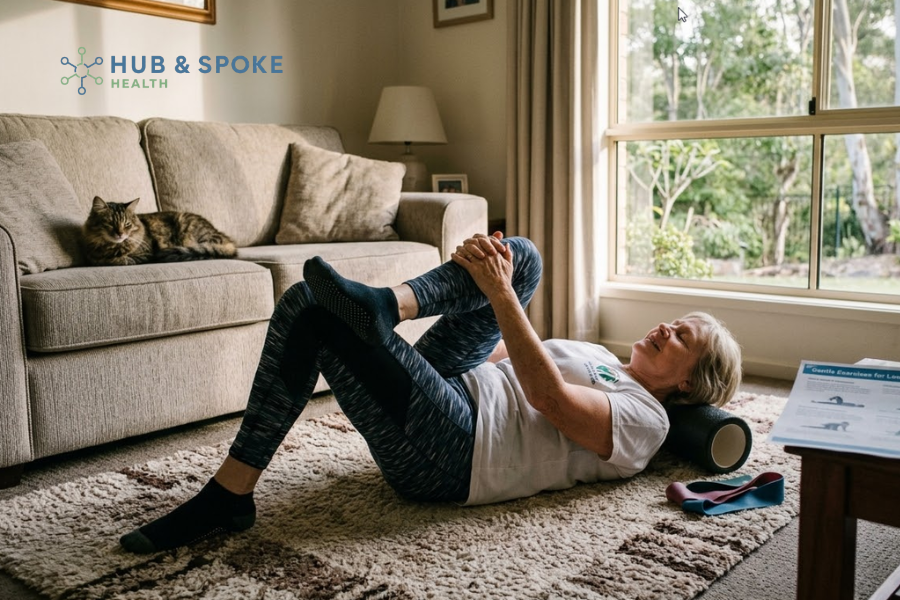
Back pain exercises for elderly adults can reduce stiffness, strengthen the spine, and improve daily mobility without leaving home. Gentle, targeted movements like pelvic tilts, seated trunk rotations, and bridges activate the core muscles that support your lower back and help prevent pain from worsening over time.
Chronic back problems affect 27% of Australians aged 65 to 74, making it one of the most common musculoskeletal conditions in older adults [1]. Back pain also tends to be more debilitating for elderly people compared to younger adults, often limiting independence and reducing confidence in everyday tasks like bending, lifting, or even walking to the letterbox [2].
This guide covers eight physiotherapist-recommended exercises organised by ability level: four seated exercises for those who prefer a chair, and four floor-based movements for those with more mobility. You’ll also find safety guidelines, red flags to watch for, and when to get professional help.
Before you begin: These exercises suit most elderly adults with general back pain or stiffness. If you have a specific spinal condition (such as a recent fracture, severe osteoporosis, or spinal surgery), speak with your doctor or physiotherapist before starting. Your GP can refer you under a Chronic Disease Management Plan for subsidised physiotherapy sessions.
Why Back Pain Gets Worse with Age
Several changes in the spine and supporting muscles contribute to back pain in older adults.
Intervertebral discs lose hydration and height as you age. This disc degeneration, sometimes called degenerative disc disease, reduces the cushioning between vertebrae and increases pressure on surrounding nerves. Facet joints in the spine can develop osteoarthritis, causing stiffness and pain with movement.
Spinal stenosis (narrowing of the spinal canal) becomes more common after age 60 and can cause pain, numbness, or weakness in the legs. Reduced bone density from osteoporosis also makes the spine more vulnerable to compression fractures.
The most controllable factor is muscle strength. Inactivity weakens the core muscles that support your spine. Weak abdominal and back muscles force the spine to bear more load on its own, which amplifies pain. That is exactly why targeted exercises are the first-line treatment recommended by physiotherapists for elderly back pain [3].
Safe Chair-Based Back Exercises for Seniors
Chair-based exercises suit elderly adults who have difficulty getting on and off the floor, have balance concerns, or are new to exercising for back pain. Use a sturdy, armless chair on a non-slip surface. Keep your feet flat on the ground throughout each exercise.
Seated Cat-Cow Stretch
Targets: Spine flexibility, upper and lower back tension
- Sit toward the front of your chair with feet flat and hip-width apart. Place your hands on your knees.
- Cow position: Inhale slowly. Push your chest forward, arch your lower back gently, and look up toward the ceiling. Your belly moves forward.
- Cat position: Exhale fully. Round your spine, tuck your chin toward your chest, and pull your belly button toward your spine.
- Flow between these two positions for 8 to 10 repetitions, matching each movement to your breath.
Seated cat-cow stretches mobilise the entire spine, from the lower lumbar region through to the upper thoracic vertebrae. Physiotherapists frequently prescribe this exercise as a warm-up for elderly patients because it gently increases spinal range of motion without loading the joints [4].
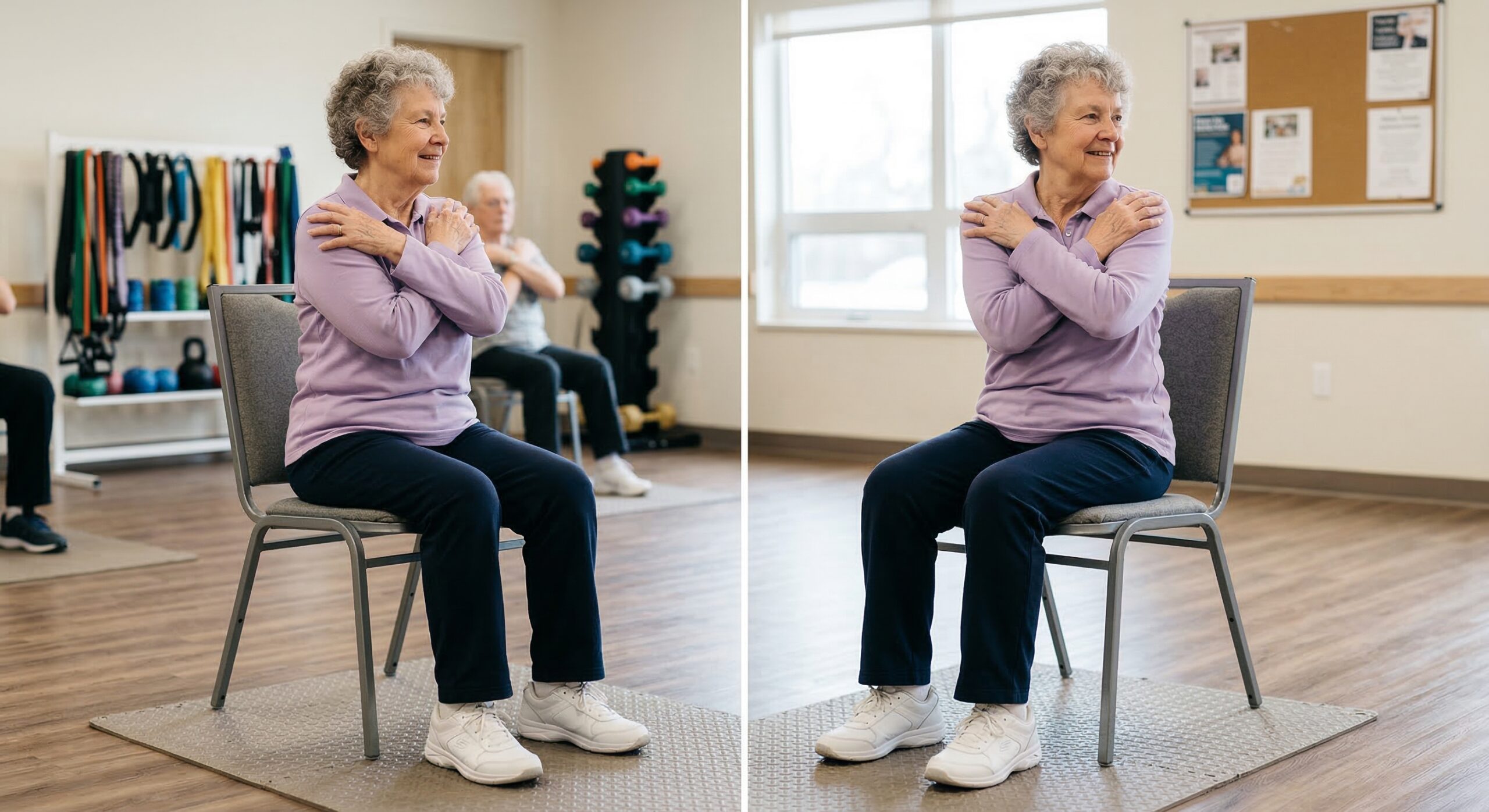
Seated Trunk Rotation
Targets: Lower back stiffness, thoracic spine mobility
- Sit upright with feet flat and arms crossed over your chest, hands resting on opposite shoulders.
- Slowly rotate your upper body to the right, keeping your hips facing forward. Your head should turn with your shoulders.
- Hold for 5 seconds, then return to centre.
- Repeat to the left.
- Complete 8 to 10 repetitions on each side.
Trunk rotations target the muscles along the sides of your spine (the obliques and spinal rotators). These muscles often tighten from prolonged sitting. Rotating through a controlled range of motion helps restore movement and reduce stiffness in the mid and lower back.
Seated Forward Bend
Targets: Lower back, hamstrings
- Sit toward the front of your chair with feet slightly wider than hip-width apart.
- Keep your back straight and slowly bend forward from your hips (not your waist).
- Slide your hands down your shins or toward the floor, going only as far as feels comfortable.
- Hold for 15 to 20 seconds, breathing steadily.
- Slowly sit back up using your hands on your thighs for support.
- Repeat 3 times.
Tight hamstrings pull on the pelvis and increase strain on the lower back. Seated forward bends lengthen the hamstrings and the long muscles that run along the spine (the erector spinae), relieving tension in both areas simultaneously.
Seated Knee Lift
Targets: Core activation, lower abdominal muscles
- Sit back in your chair with your back supported. Hold the sides of the seat for stability.
- Engage your abdominal muscles by gently drawing your belly button inward.
- Lift your right knee toward your chest, raising it only as high as is comfortable. Keep the movement slow and controlled.
- Hold for 3 seconds, then lower your foot back to the floor.
- Repeat with the left knee.
- Complete 8 to 10 repetitions on each side.
Seated knee lifts strengthen the lower abdominal muscles and the hip flexors. A stronger core reduces the load on your lumbar spine during daily activities like standing up from a chair, bending, or walking.
These four chair exercises take approximately 10 to 12 minutes to complete. Once they feel comfortable and you can perform all repetitions without increasing your pain, floor-based exercises can add deeper strengthening.
Floor-Based Exercises to Strengthen the Lower Back
Floor exercises offer greater range of motion and stronger muscle activation than chair-based alternatives. Use a yoga mat or thick towel on a firm surface. If getting down to the floor is difficult, ask someone to be nearby, or perform these on a firm bed (not a soft mattress, which reduces effectiveness).
Pelvic Tilt
Targets: Core activation, lumbar spine support
- Lie on your back with knees bent and feet flat on the floor, hip-width apart.
- Gently tighten your abdominal muscles and press your lower back flat into the floor. Imagine you’re trying to close a small gap between your back and the mat.
- Hold for 5 seconds, breathing normally.
- Relax and let your back return to its natural curve.
- Repeat 10 to 15 times.
Pelvic tilts are one of the most recommended exercises for elderly lower back pain. They activate the deep core stabiliser muscles (particularly the transverse abdominis) without requiring any spinal bending or loading. Physiotherapists often use pelvic tilts as a baseline assessment tool to determine how well a patient can engage their core before progressing to harder exercises [3].
Bridge
Targets: Glutes, lower back, core
- Lie on your back with knees bent, feet flat and hip-width apart. Place your arms at your sides.
- Squeeze your glutes and abdominal muscles, then slowly lift your hips off the floor until your body forms a straight line from your shoulders to your knees.
- Hold for 5 to 10 seconds at the top.
- Slowly lower your hips back to the floor.
- Repeat 10 times.
Bridges strengthen the gluteal muscles, which are among the most important supporters of the lower spine. Weak glutes force the lower back muscles to compensate during walking and standing. Research from Harvard Health confirms that bridge exercises reduce lower back pain by building the posterior chain (glutes, hamstrings, and spinal erectors) without compressing the spine [5].
Knee-to-Chest Stretch
Targets: Lower back tension, hip flexibility
- Lie on your back with both knees bent and feet flat on the floor.
- Using both hands, gently pull your right knee toward your chest. Keep your left foot flat on the floor and your lower back pressed gently into the mat.
- Hold for 20 to 30 seconds, breathing deeply.
- Slowly lower your right leg and repeat with the left.
- Complete 3 repetitions on each side.
Knee-to-chest stretches lengthen the lower back muscles and the piriformis (a deep hip muscle that often contributes to lower back and sciatic-type pain in older adults). Hold times of 20 to 30 seconds allow the muscle fibres and fascia to gradually release tension [4].
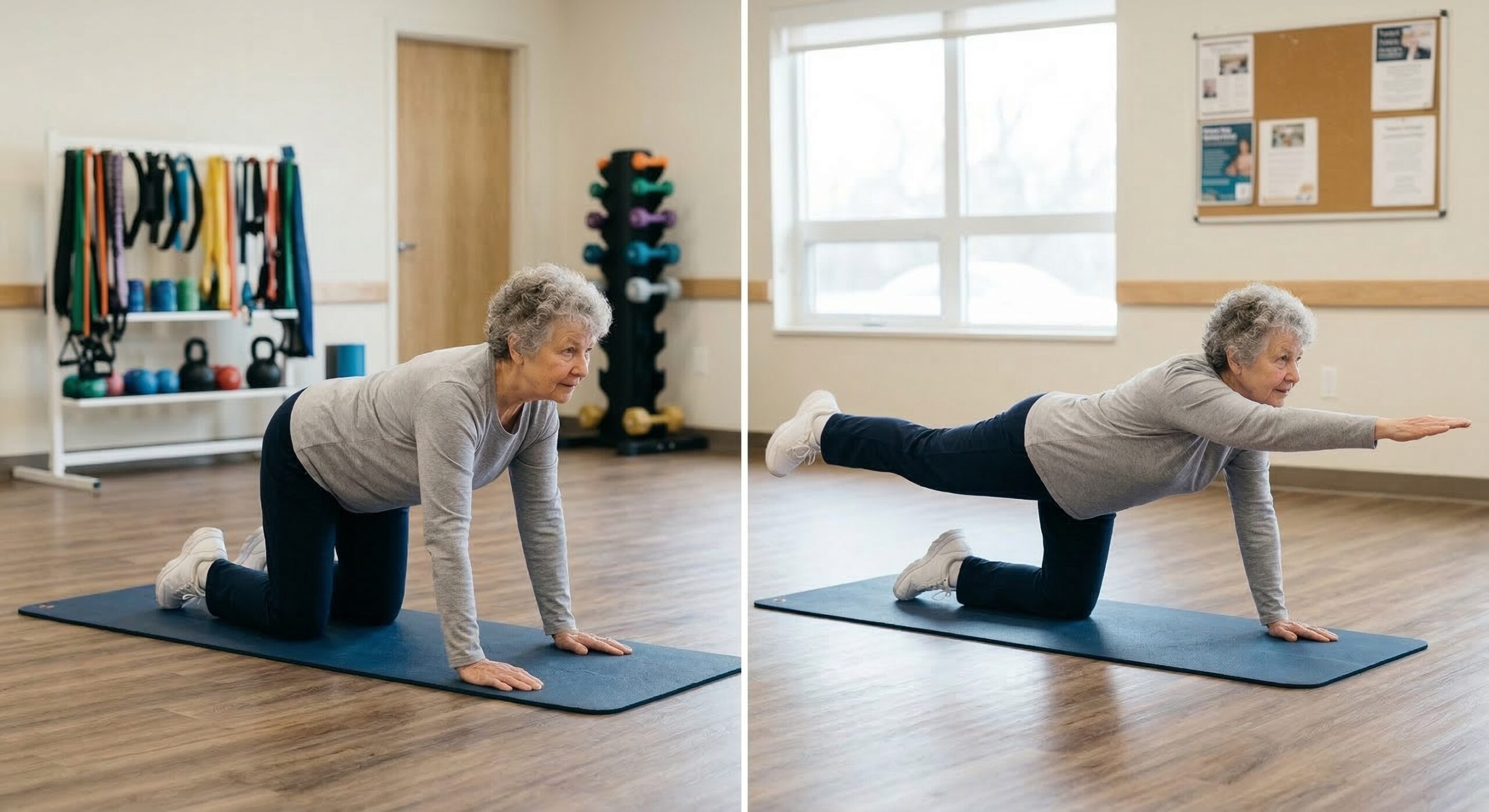
Bird-Dog
Targets: Core stability, balance, back extensors
- Start on your hands and knees, with wrists directly under your shoulders and knees under your hips. Keep your back flat (imagine balancing a cup of tea on your lower back).
- Slowly extend your right arm forward and your left leg straight back, keeping both parallel to the floor.
- Hold for 5 seconds, focusing on keeping your core tight and hips level.
- Return to the starting position.
- Repeat with the left arm and right leg.
- Complete 8 repetitions on each side.
Bird-dog exercises train the muscles along the spine (the multifidus and erector spinae) to stabilise the trunk while your limbs move. This mimics real-world actions like reaching for something on a high shelf while standing on one foot. Improved trunk stability from bird-dogs directly reduces the risk of back pain flare-ups during daily activities [5].
Daily Walking and Back Pain in Older Adults
Walking is the simplest and most important supplement to back exercises for elderly adults. Physiotherapy guidelines consider a regular walking programme the foundation of back pain management in seniors [3].
Start with 5 minutes of flat, even-surface walking at a comfortable pace. Add 1 to 2 minutes each week until you reach 20 to 30 minutes per session. If spinal stenosis causes pain during walking, try interval walking: walk until symptoms increase, sit and rest for 1 to 2 minutes, then resume. This approach builds endurance without pushing past your pain threshold.
Walking strengthens the muscles that support your spine, increases blood flow to spinal discs (which rely on movement for nutrient delivery), and improves balance. These three benefits reduce both back pain and fall risk, which affects 1 in 3 Australians over 65 each year [6].
Safety Guidelines for Elderly Back Exercises
Safe exercise requires preparation and awareness. Follow these guidelines to reduce your risk of injury.
Before you start:
- Warm up for 3 to 5 minutes with gentle walking or marching on the spot. Cold muscles are more prone to strain.
- If your back feels particularly stiff, apply a heat pack or warm towel to your lower back for 15 to 20 minutes before exercising. Heat increases blood flow and relaxes tight muscles [7].
- Wear comfortable, non-restrictive clothing and supportive, non-slip footwear (or go barefoot on a yoga mat).
During exercise:
- Move slowly and with control. Fast, jerky movements increase injury risk.
- Breathe through each movement. Exhale during the effort phase. Never hold your breath, as this raises blood pressure.
- Stop if you feel sharp pain, dizziness, or unusual symptoms. Mild muscle soreness the next day is normal. Sharp pain during the exercise is not.
- Start with fewer repetitions than listed and increase gradually over weeks. Progress looks like 6 reps in week one, 8 reps in week two, 10 reps in week three.
Red flags: when to stop and see a doctor
| Symptom | What It Could Indicate |
| Pain radiating down one or both legs | Sciatica or nerve compression |
| Numbness or tingling in legs or feet | Nerve involvement |
| Sudden loss of bladder or bowel control | Cauda equina syndrome (seek emergency care) |
| Pain that worsens with rest, not activity | Possible inflammatory or systemic condition |
| Sudden severe pain after a fall | Possible vertebral fracture |
| Weakness in one or both legs that doesn’t resolve | Nerve damage or spinal cord compression |
Ongoing back pain? If your pain persists for more than two weeks despite gentle exercise, or if any of the symptoms above apply to you, consult a physiotherapist or your GP. Our guide on how to reduce muscle stiffness naturally also covers complementary strategies like hydration, magnesium-rich foods, and heat therapy.
Frequently Asked Questions
What is the best exercise for elderly with lower back pain?
Pelvic tilts and bridges are among the most effective starting exercises for elderly lower back pain. Pelvic tilts activate the core without placing excessive load on the spine, and bridges strengthen the glutes that support the lumbar region. A physiotherapist can recommend the best starting exercise based on your specific condition and mobility level [3][5].
Should elderly people with back pain rest or exercise?
Gentle exercise is better than prolonged rest for most types of chronic back pain. Extended bed rest weakens the muscles that support the spine and can worsen pain over time. Start with low-impact movements like seated stretches, pelvic tilts, or short walks of 5 to 10 minutes. Gradually increase as your body allows [3][4].
Can back exercises be done in bed for elderly?
Yes. Pelvic tilts, knee-to-chest stretches, and supine twists can all be performed on a firm mattress. Bed-based exercises suit elderly adults who find it difficult to get on and off the floor safely. A softer mattress reduces the effectiveness of these exercises, so choose the firmest surface available or place a yoga mat on the floor beside the bed as an alternative.
How often should elderly people do back exercises?
Most physiotherapy guidelines recommend performing gentle back exercises 3 to 5 times per week for best results. Daily practice of the seated exercises is safe for most people. For floor exercises, every other day allows muscles adequate recovery time between sessions. Consistency over weeks and months matters more than intensity in any single session [4].
Start Moving, Reduce Your Pain
The exercises in this guide are a starting point. Consistent, gentle movement is the most effective way for older adults to manage back pain and maintain independence at home. Begin with the seated exercises if you’re unsure of your ability, and add floor-based movements as your strength and confidence improve.
References
[1] AIHW. (2015). “Chronic Back Problems in Older Australians.” Retrieved from aihw.gov.au[https://www.aihw.gov.au]
[2] CQU. (2023). “Back Pain in Older Adults.” Retrieved from cqu.edu.au[https://www.cqu.edu.au]
[3] Mayo Clinic. (2024). “Back Exercises in 15 Minutes a Day.” Retrieved from mayoclinic.org[https://www.mayoclinic.org]
[4] AARP. (2024). “Exercises for Lower Back Pain.” Retrieved from aarp.org[https://www.aarp.org]
[5] Harvard Health. (2024). “Core Exercises for Back Pain.” Retrieved from harvard.edu[https://www.health.harvard.edu]
[6] Hub & Spoke Health. (2025). “Falls Prevention & Balance Training.” Retrieved from hubandspoke.health[https://hubandspoke.health/falls-prevention-balance-training/] [7] Healthline. (2024). “Muscle Rigidity.” Retrieved from healthline.com[https://www.healthline.com]